
Best Indicators for Forex Trading Maximizing Your Trading Potential 1833824969

Best Indicators for Forex Trading: Maximizing Your Trading Potential
Forex trading, with its potential for high returns, requires traders to make decisions based on market analysis. One of the keys to successful trading is understanding and utilizing various indicators. Choosing the right indicators can significantly increase your success rate. In this article, we will explore some of the best indicators for Forex trading to help you navigate the foreign exchange market more effectively, and you can get more insights on platforms like best indicators for forex trading Trading Platform VN.
1. Moving Averages
Moving averages, particularly the Simple Moving Average (SMA) and the Exponential Moving Average (EMA), are widely used in Forex trading. They help smooth out price action and filter out noise, enabling traders to identify the overall trend direction.
For instance, when the price is above the moving average, it may indicate an uptrend, whereas if it’s below, it may signal a downtrend. Traders commonly use crossovers of short-term and long-term moving averages to identify potential buy or sell signals.
2. Relative Strength Index (RSI)
The Relative Strength Index (RSI) is a momentum oscillator that measures the speed and change of price movements. It ranges from 0 to 100 and is typically plotted over a period of 14 days. The RSI helps traders identify overbought or oversold conditions in the market.
An RSI above 70 may indicate an overbought market, suggesting that a price correction could soon follow. Conversely, an RSI below 30 indicates an oversold market, potentially signaling a price increase. This makes RSI an effective tool for timing entries and exits in Forex trading.
3. Bollinger Bands
Bollinger Bands are a volatility indicator that consists of a middle band (SMA) and two outer bands representing standard deviations from the middle band. They provide traders with insights regarding market volatility and potential price reversals.
When the price touches the upper band, it may indicate that the asset is overbought, while touching the lower band could signal that it is oversold. Traders often look for price patterns near these bands to help determine their next trading moves.
4. Stochastic Oscillator
The Stochastic Oscillator is a momentum indicator comparing a particular closing price of a currency pair to its price range over a specific period. The values range from 0 to 100, with readings above 80 typically indicating overbought conditions and readings below 20 indicating oversold conditions.
Traders often use the Stochastic Oscillator in conjunction with other indicators to confirm trends or reversal signals, making it a valuable tool in Forex trading strategies.
5. MACD (Moving Average Convergence Divergence)
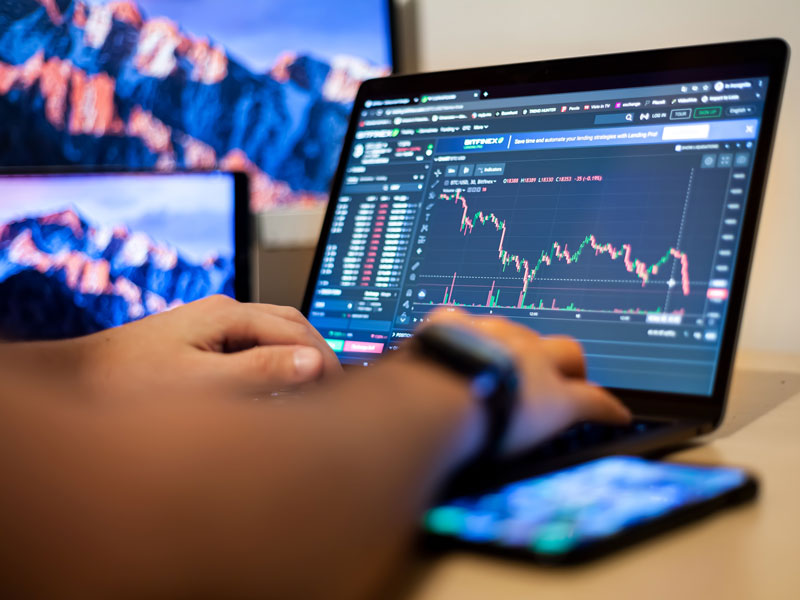
The MACD is a trend-following momentum indicator that shows the relationship between two moving averages of a security’s price. It consists of the MACD line, signal line, and histogram. Traders use the MACD to identify bullish or bearish momentum based on the position of the MACD line relative to the signal line.
Crossovers between the MACD and signal line can signal potential entry or exit points, while the histogram displays the strength of the trend, helping traders gauge the momentum behind their trades.
6. Fibonacci Retracement Levels
Fibonacci retracement levels are horizontal lines that indicate where support and resistance are likely to occur, using horizontal lines to indicate areas of interest at the key Fibonacci levels (23.6%, 38.2%, 50%, 61.8%, and 100%). Traders use these levels to determine potential reversal points in the market.
By applying Fibonacci levels to recent price movements, traders can identify buying and selling opportunities at levels where prices are likely to reverse or bounce back, providing a valuable tool for price prediction.
7. Average True Range (ATR)
The Average True Range (ATR) is a volatility indicator that measures market volatility by decomposing the entire range of an asset for that period. It is used by traders to assess the potential for price movements and to adjust position sizes accordingly.
High ATR values suggest high volatility, making it a suitable environment for trading strategies like breakout trading. Conversely, low ATR values indicate lower volatility, a condition where traders may prefer to minimize risk exposure.
8. Volume
Volume is one of the most critical indicators in Forex trading that can validate trends. It measures the number of trading units during a specified period. High volume during a price move can suggest a strong trend, confirming that the movement is backed by strong trader interest.
Conversely, low volume during a price move may hint at weakness in a trend, suggesting that the move might not be sustained. By coupling volume analysis with other indicators, traders can gain a clearer picture of potential price movements.
9. Ichimoku Cloud
The Ichimoku Cloud is a comprehensive indicator that defines support and resistance, identifies trend direction, and provides trading signals in one view. It consists of five lines, each representing different time frames and averages, creating a visual representation of market equilibrium.
Traders can use the cloud’s colors and thickness to determine bullish or bearish sentiments in the market. When the price is above the cloud, it typically indicates a bullish trend, while prices below suggest a bearish trend. This multi-faceted indicator is ideal for those looking for detailed analysis on Forex trades.
Conclusion
Choosing the right indicators can make all the difference in Forex trading. Each indicator provides unique insights, and many traders successfully use combinations of these tools to create their trading strategies. It’s essential to experiment and apply these indicators in a demo trading environment to find the best fit for your trading style. Always combine technical indicators with a robust risk management strategy and stay informed about market conditions to maximize your trading potential.
Leave a Reply